



.
By Ednie Luceño-Casiller, Partnership Manager, Foundation for a Sustainable Society, Inc. (FSSI), and Lasalette Gumban, Strategic Management Group Head for National Confederation of Cooperatives (NATCCO)
In rural communities where access to basic services and economic opportunities often fall short, social enterprises are stepping in to fill the gap. They help farmers earn a fair price, connect women to safer work, and bring essential goods to remote areas. But while their impact is visible on the ground, support is often short-term and not designed for scale.
Many face barriers such as limited access to capital and investment, restricted market access, and inadequate infrastructure and public services, according to the Foundation for a Sustainable Society, Inc. (FSSI) 2024 study on the landscape of social enterprises in the Philippines, while global analyses also highlight persistent financing and visibility challenges according to an insight report by the World Economic Forum in 2024.
We need a better way to back solutions that are built to last. This is where co-financing, a collaborative model in which partners pool resources, share risk, and align accountability, makes a difference—where capital is shared, responsibility is collective, and outcomes endure over time.
Capital that grows with the enterprise
Social enterprises, with their dual focus on profit and impact, often operate outside the mold of traditional businesses. In the Philippines, 44% are led by women, many of which are in rural areas supporting marginalized groups, but face steep financing barriers: 58% of women-led SMEs struggle with access to capital largely due to gender bias, complex loan processes, and limited financial literacy, while cooperatives often go unnoticed by the formal investor ecosystem.
Responding to these realities means designing capital that is flexible and risk-aware. Co-financing provides that adaptability by combining financial instruments with hands-on support. Here at FSSI, this includes loans, seed capital, equity, and deposits, paired with capacity building, knowledge sharing, and advocacy.
Bringing this approach on the ground, we partner with our member organizations such as the National Confederation of Cooperatives (NATCCO), which strengthens governance, provides supervision and stabilization guidance, and financial support—primarily in the form of loans—to reduce enterprise risk and maximize impact. In this way, co-financing adapts to the stage and needs of each enterprise, supporting the growth and impact of women-led and early-stage ventures without forcing them into rigid models.
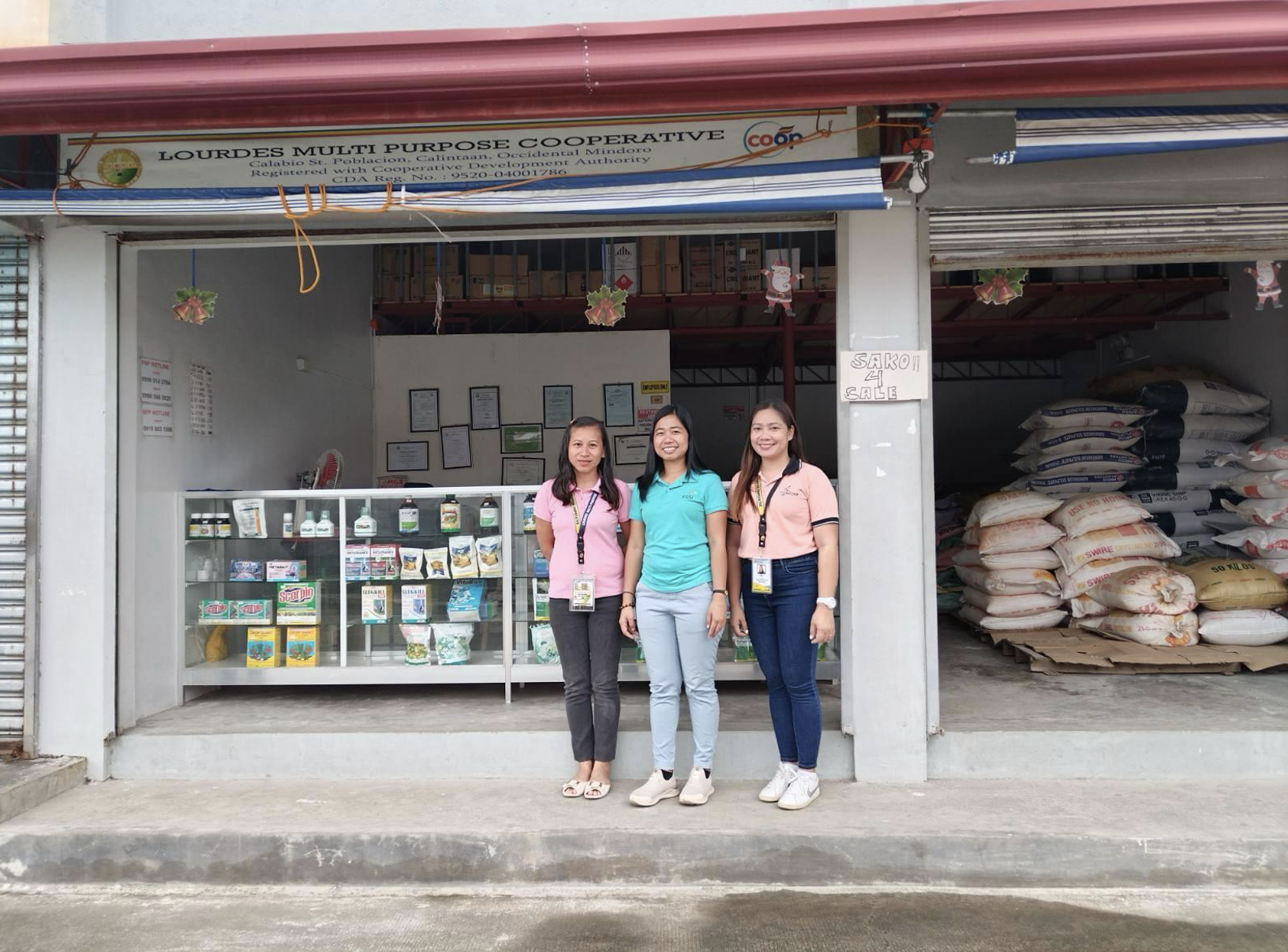
During a field visit, FSSI Partnership Manager Ednie Luceño-Casiller spent time with the team of Lourdes MPC–Calintaan’s agri-supply store—Branch Manager Crislyn Joy de Luna and cashier Mylene Dioso—supporting their shared goal of making farm inputs and loans more affordable, and helping farmers build more secure livelihoods for the long term.
We have seen this in Occidental Mindoro, where Lourdes Multi‑Purpose Cooperative (MPC) operates an FSSI‑supported agri‑supply store providing affordable farm inputs, agri‑loans, and financial services to help farmer‑members reduce costs, diversify income, and improve climate‑resilient planning. In North Cotabato, where Kisandal Multi-Purpose Cooperative supports farmers and community members by providing agricultural financing, trading, and general merchandise through its agri supply and general store operations. And in Sultan Kudarat, where Bacbacan Multi-Purpose Cooperative (MPC) provides financial services and agri-loans to support local farmers, strengthen livelihoods, and promote cooperative growth.
Working together to build stronger enterprises
At its best, co-financing works when we mobilize capital alongside partners such as cooperative federations, development organizations, and the private business sector to ensure investments are deployed responsibly and sustained over time.
For instance, while we mobilize, pool, and coordinate funding for social enterprises, NATCCO provides loan-based financial support and technical assistance, guiding enterprises from needs identification to capacity-building and hands-on support.
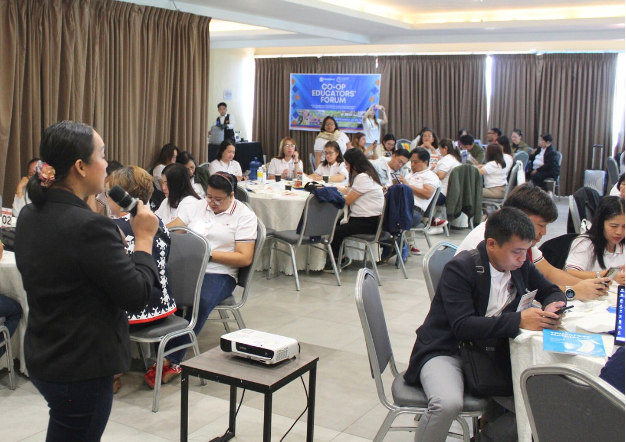
NATCCO convened cooperative educators at the Coop Educator’s Forum 2025 to strengthen strategies for member learning, foster innovation, and integrate digital tools in support of community leaders. Photo from Natcco Network.
NATCCO’s broader intermediary expertise—streamlining processes, managing risk, and built-up small financing needs—also complements co-investment efforts by adapting funding to local contexts and ensuring resources meet community needs across financial inclusion, disaster preparedness, climate action, and livelihoods. In doing so, co-financing makes it easier for social enterprises to secure funding, sustain operations, and scale impact.
When various financial service providers and enterprise support organizations align in this way, social enterprises become more resilient, more accountable, and better equipped to sustain their impact over time.
Rethinking what “returns” really mean
Over the years, working with social enterprises has taught us to measure success in ways that go beyond profit. We’ve learned to look at what we call the triple bottom line (3BL) of people, planet, and profit, which means valuing not just financial gains, but also social impact and environmental care.
We see returns in enterprises that can weather shocks, in stable rural livelihoods, in women-led cooperatives that no longer rely on subsidies, and in farming communities shifting to sustainable practices.
Co-financing allows us to take that broader view of risk and reward, and to support enterprises that prioritize both inclusion and income. And when we spread the investment, we also share responsibility for ensuring that enterprises have the governance, systems, and support needed to grow sustainably and equitably.
A way forward
If we want social enterprises to thrive, we need to change how we fund them and how we work alongside them.
This means more funders must be willing to share risks and coordinate efforts. Policymakers must create space for blended finance models that support both scale and inclusion. And intermediaries like cooperative networks must continue building the systems, supporting the people, and fostering the trust needed for enterprises to grow without compromising their values.
There is no single blueprint for this. But the path we must take forward is one of support that is strategic, long-term, and grounded in trust.
As institutions working from different points in the system, we remain committed to working with partners who believe in this vision. Because when we invest together and bring shared purpose to the table—we help build an economy where social enterprises do more than survive.
They lead and empower.
